
Why Dictionaries
Dictionaries Matter
A dictionary is more than a reference book. It teaches students how to discover the meaning of new words, understand pronunciation and spelling, expand their vocabulary, and strengthen communication skills. It encourages critical thinking by helping students work through unfamiliar concepts, rather than simply searching for immediate answers.
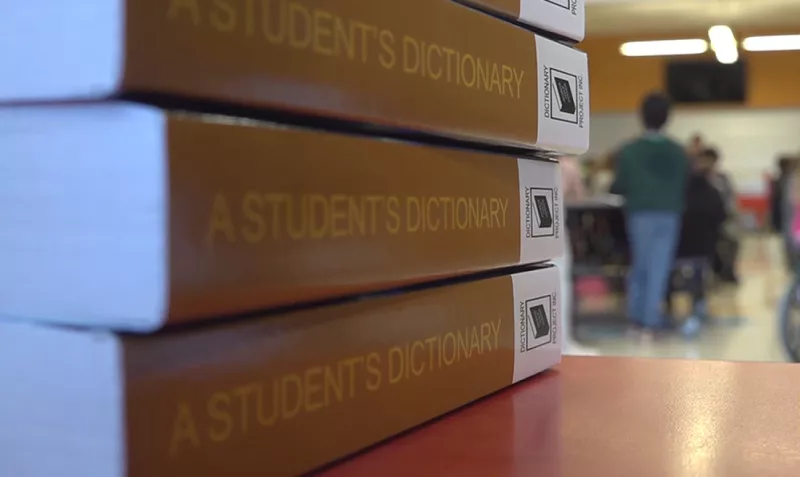
For many children, the dictionary they receive through The Dictionary Project becomes one of the first books they truly own. It is a gift they can keep for years, use both at school and at home, and share with their families. That single gift often becomes a lasting reminder that someone in their community believes in their education and their future.
A dictionary is a map to the world of words...
Stories transport us to new worlds, and dictionaries help us navigate the way.
See the words you know in a new light...
The thrill of finding familiar words in a dictionary is like the thrill of finding your street on a map. Seeing cat defined as “a small domestic meat-eating mammal kept by people as a pet or for catching rats and mice” invites a reexamination of the familiar. Words don’t just exist in context; they have precise meanings that can be distilled into simple phrases.
Discover the words you don’t know...
Even maps of the places we know abound with unfamiliar roads and rivers. In a print dictionary, children quickly discover new words right next to known ones. On the page where elbow rests they find that to be elated is to be filled with joy or pride. Near question they learn that query means “something asked.” Their eyes fall on salty and salutation is there to discover: “an expression of greeting, goodwill, or courtesy.”
Enjoy the pleasure of wandering through a book...
Most books have a recommended approach: start at the beginning and proceed page by page until the end. As with maps, dictionaries make no such demands. Start anywhere you like, stop anywhere you like, and wander freely along the way. It is necessarily a slower way of accessing information—and it’s a delightful way to lose track of time.
Learn the language’s topography...
Today’s kids will have a life full of written language. From texting to email to blogging to social media, they’ll rely on written words far more than their grandparents ever did. A dictionary tells them which category each word belongs to— its “part of speech," how to pronounce it, what forms the word takes, and what the word’s various meanings are. With access to this information they gain an intimacy with the language that gives them the fluency they need to communicate.
Peek behind the curtain...
Most of us don’t look at a map’s key until we see something that we don’t quite understand. In a dictionary, the equivalent of the map’s key is found in the first few pages, where all the various features of a dictionary entry are explained. The child adventurous enough to read here will find the logic and reason behind the book’s main content.
Just as the best adventures on land require a map, the greatest adventures in the world of words are vastly improved when undertaken with a dictionary in hand. Give a child a dictionary, and the world of words is theirs.


Every day people ask me if dictionaries will be used in the future. In fact, printed dictionaries are of more value than ever in order to expand the English language. The people who speak English have to constantly acquire a larger vocabulary or the language will diminish. Nothing stays the same, it grows or it shrinks. Language is not static. If students do not learn new words they will not have the ability to do a job that requires reading and writing.
For 30 years I have heard people say we don’t need or use dictionaries. That is true for many people and for that reason they are professional students, stuck in a menial job, unemployed or in prison. That might sound simplistic or dramatic but it is a fact that people who use dictionaries are smarter and more self-reliant than people who do not use them. Reading is the only way out of poverty.
A dictionary is a companion that helps students understand what they are reading. A person who knows only 5,000 words is considered functionally illiterate. They can’t spell words correctly or follow instructions because they do not know the meaning of the words spoken or in print. They rely on AI and YouTube to explain and guide them through the world around them. Their knowledge is based on artificial intelligence, not actual intelligence; their own understanding and problem solving skills, like the ability to troubleshoot a problem of a technical or mechanical nature. A dictionary teaches children how to approach a problem using critical thinking skills by learning to sound out a word and find it in the dictionary. This simple task expands their frame of reference, and gives them a feeling of satisfaction and self confidence that they cannot get on the internet.
Dictionaries have evolved dramatically because language is driven by technology. Technology controls the economy and languages all over the world. We have an online dictionary formatted in the same way that the Word of the Day is presented. The online dictionaries are convenient and helpful to people who have a vocabulary of over 10,000 words, because they can use that platform to form associations with other people and their ideas.
The iPad and the Chromebook made their debut in 2010. They are in every school in America. Our government spent over $30 billion dollars to replace textbooks with laptops and tablets, making the proposition that our students would fall behind in education if they did not have access to these devices all day. Sadly, after making this investment, we are further behind than ever in our quest to improve education. The result is the first generation less cognitively capable than their parents.
We cannot replace people with devices, because when we do, individuals lose their value and character in our society. For many, especially children, it is hard to distinguish facts from fiction on the internet. Many important values, skills and talents are being lost because electronic forms of entertainment are not a substitute for reading and writing.
When I ask people how we can improve education, they say that schools need to teach character. Character is taught by example: showing people respect. A machine cannot give the compassion and humanity of a person. Part of teaching is showing people how to communicate with and respect others. Interacting with people gives them a chance to observe each other; this is a teachable moment.
Without personal contact, children are not using their five senses that make them aware of their surroundings. We must reevaluate our relationship with our electronic devices and focus on our inner resources. Technology cannot replace the human need to relate. The one attribute that no one can take away from us is our attitude. By visiting classrooms, talking with students, giving them a dictionary and encouraging the students to succeed, our sponsors demonstrate good character, respect and leadership. It is by helping others that we help ourselves grow into stronger and better people.
The dictionaries donated by individuals and civic organizations have changed the lives of the people who received the books. Most people do not realize that the dictionary the student receives is often the only book in the house. In the homes where the parents do not speak English, they ask their children to teach them English using the dictionary. The dictionary is a gift of knowledge bestowed on the children in their school to help them with their homework and school work. It enriches their lives. A dictionary is an essential tool for a quality education. A child cannot understand our language and spell words correctly without one.
Students learn from the example of the sponsors to appreciate the gift that they have been given to help them become well educated leaders. Citizens have to engage in a democracy, freedom requires civic responsibility. Instilling a sense of social responsibility is just as important as personal freedom and individualism, and strikes a healthy balance in their relationships with people. A dictionary is the best gift anyone can give because it makes them self-reliant and better able to communicate.
Mary French, Founder of The Dictionary Project